
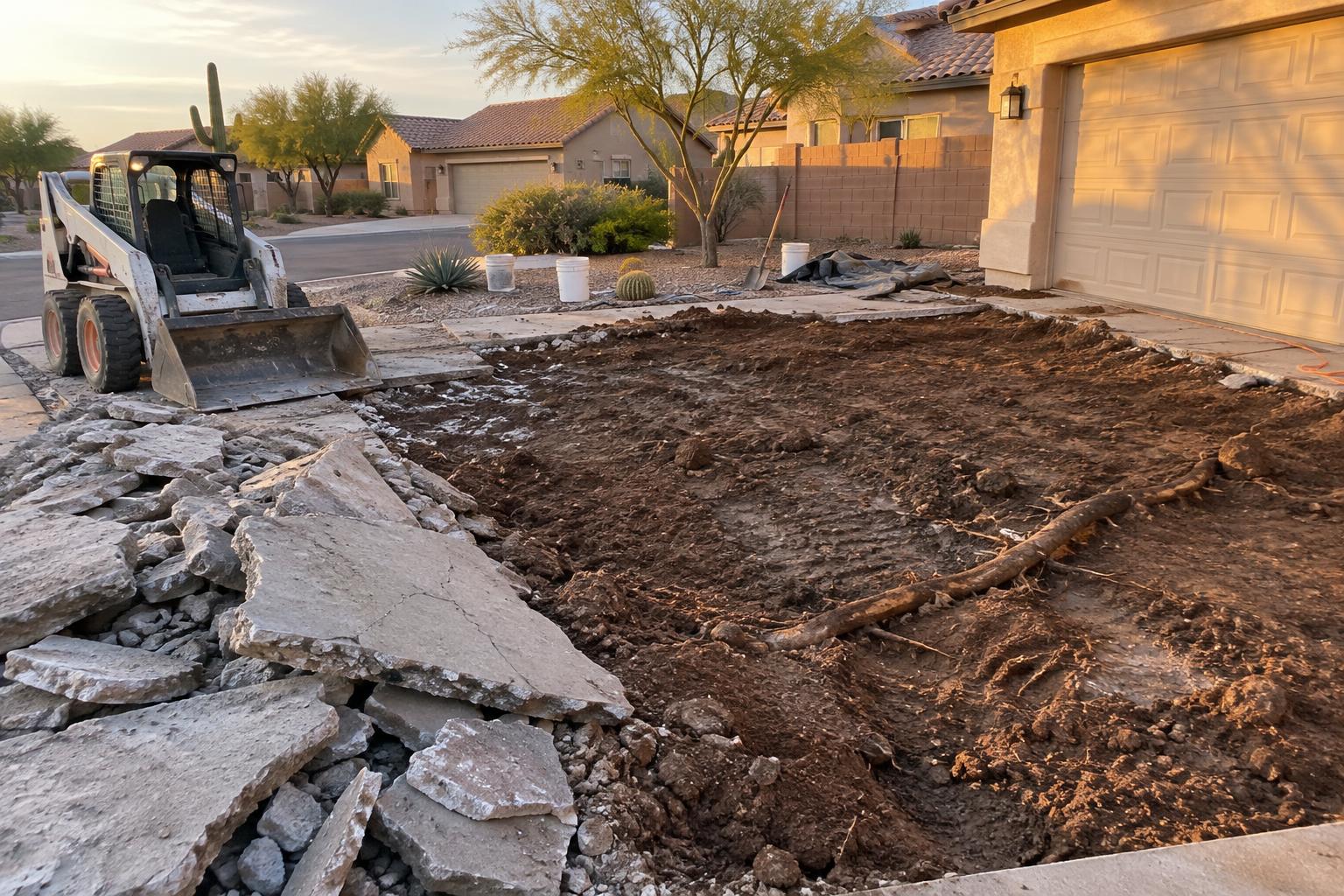
Downtown Mesa's older houses sit on expansive clay laced with caliche, and after decades of flood irrigation, mature shade trees and 110-degree summers, a lot of their driveways have cracked, lifted at the edges or settled near the street. Many of these slabs were poured long ago, often thinner than what goes in today and sometimes straight onto native soil. Now they hold water, catch toes at the sidewalk and make the house look tired from the curb.
Replacing one is a straightforward job when it's planned around the ground underneath. This post walks through how we approach driveways in the neighborhoods around Main Street, the Temple area and the historic districts near downtown, so you know what to look for in a concrete driveway contractor before anyone breaks out the old slab.
What Downtown Mesa's Ground Does to an Old Driveway
Clay expands when it gets wet and shrinks as it dries. In much of Downtown Mesa that cycle runs harder than in newer subdivisions because many older lots still take flood irrigation. A yard that floods on a schedule keeps the soil under the driveway edge swinging between soaked and bone dry. Monsoon storms add another round, pushing water across the slab and into every open crack.
Caliche is the other half of the story. It's a hard, cemented layer that can sit a few inches down or much deeper, and it drains poorly. Water that gets through the clay can pool on top of it and soften the soil right where the slab needs support.
Then there are the trees. Ash, pecan, mulberry and eucalyptus planted generations ago now have roots running under driveways and sidewalks. Those roots lift panels, and the lifted edge becomes the first place to crack. Add years of direct sun, which dries the surface and breaks down any sealer, and you get the typical downtown driveway: a web of cracks, a heaved panel near the tree, and a low spot by the garage where water sits after a storm.
Why the Tear-Out Tells You What Went Wrong
Once the old concrete comes up, the ground underneath explains the damage. We look at the thickness of the broken edges, whether there was any gravel base at all, and what the soil looks like. A thin slab sitting directly on dark, damp clay with a root running through it is common on older downtown lots, and it tells us the new driveway needs a deeper dig and a real base.
Roots that pushed up the old slab get cut back where it's reasonable to do so. Soft or organic soil gets dug out. If we hit caliche, we decide whether to break through it or grade on top of it, depending on how it sits and how water will move across the lot. This is also when we look at the apron and the connection to the public sidewalk. The city has requirements for work at the curb, and an older apron is often the most broken piece of the whole driveway, so that section gets planned with care.
Building the Base for Clay, Caliche and Irrigation Water
A good base is the part of the job you never see again, and it does most of the work. After excavation, we bring in aggregate base, spread it in layers and compact each one so the slab has an even, firm surface to rest on. On clay, that layer also adds some separation between the concrete and the wettest soil.
Grading matters just as much. The finished driveway should shed water toward the street or a planned drainage path, away from the house and the garage door. On flood-irrigated lots, we pay close attention to the edge facing the yard, because that's where irrigation water pushes hardest. Forms get set to the final grade, and reinforcement goes in on chairs so it ends up in the middle of the slab where it can do its job.
Control joints are planned before the pour. Concrete shrinks as it cures and moves with temperature, and joints give those cracks a straight, intended place to form. Spacing depends on slab width and thickness, and near older trees we often add a joint where we expect the most movement.
Pouring and Curing in Mesa Heat
From late spring through early fall, we schedule driveway pours early in the morning, often starting around first light, so the concrete is placed and finished before the heat and dry air take over. Hot concrete sets faster, and a slab that dries too quickly at the surface is more likely to crack and dust.
The crew screeds, floats and edges the slab, then applies a broom finish for traction on a wet monsoon afternoon. Curing starts right away, with a curing compound or by keeping the surface moist, and continues through the first days. We'll tell you when it's ready for foot traffic and when it can take your car. If you're adding an RV pad or a driveway extension along the side yard, that section is built for the load it will carry and needs a little longer before heavy use.
Sealer helps with oil stains and sun exposure. Valley sun wears it down faster than most people expect, so plan on resealing periodically.
What to Ask a Concrete Driveway Contractor Before You Sign
A written estimate should spell out slab thickness, the type and depth of base, reinforcement, joint layout, finish and how the old concrete gets hauled away. Ask how roots and the sidewalk apron will be handled. Ask about pour timing in summer. If your street has HOA or historic-district guidelines on color or finish, bring them up early so the plan fits.
Many downtown homeowners pair a driveway with backyard work, since the same soil conditions apply. If you're picturing a shaded slab out back for a grill or seating area, our Concrete Patio Contractor page covers that work. For details on driveways, extensions, aprons and RV pads, visit our page for a concrete driveway contractor in Downtown Mesa. Estimates are free, financing is available, and you can call (602) 773-1313 to set up a visit.