
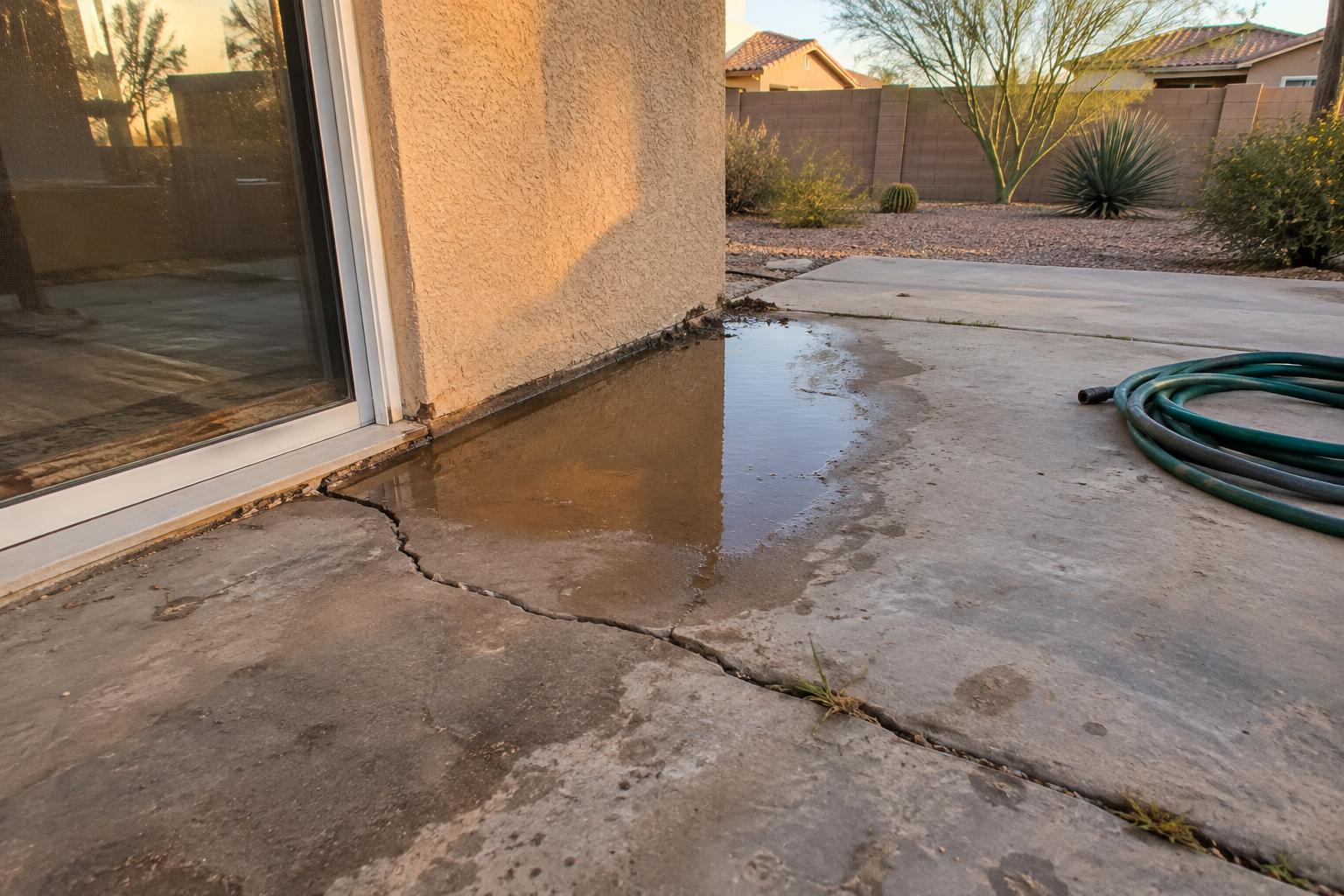
Run a garden hose across your back patio for five minutes this week and watch where the water goes. The puddles show you exactly where the slab has dropped. They also show you where the next monsoon storm will push water back toward your house. In Mesa, that simple test tells homeowners more than any photo they could send a contractor.
Most patios here were poured when the house was built, often as a small rectangle off the slider. After twenty years of summer heat, irrigation overspray and July downpours, a lot of them have a low corner, a crack running from the door frame, or a gap where the slab meets the stucco. Water collects there, sits against the foundation wall and slowly works into the soil underneath.
What the hose test tells you about your Mesa patio
A properly built patio sheds water away from the house. A gentle slope, about a quarter inch per foot, is enough to move a monsoon cloudburst off the slab and into the yard. When the hose test leaves water pooling near the back door, the slab has either settled or was poured flat in the first place.
Look at a few more things while you are out there:
- Cracks wider than a coin edge, especially ones where one side sits higher than the other - A dark line or gap where the patio meets the house - Edges that have broken off along the lawn or gravel - A chalky, faded surface where sealer has worn away in the sun
Hairline cracks are normal for concrete in the desert. Offset cracks and pooling water mean the ground below has moved. A good concrete patio contractor in Mesa will want to know why before quoting anything.
Why Mesa patios settle and crack
Mesa sits on a mix of soils. Some lots near the Salt River have sandy, loose fill. Others hit hard caliche a foot or two down. Many yards have pockets of expansive clay that swell when irrigation soaks them and shrink back during the dry months.
Each of those causes trouble when a patio goes straight onto native dirt. Loose fill compacts under weight and lets the slab sink. Clay heaves one side up after a wet stretch. Caliche looks solid, yet it holds water like a bowl, so the soil sitting on top of it stays soft. Builders in a hurry often scraped the yard, set forms and poured. That shortcut shows up years later as the problems you just found with the hose.
Sprinklers make it worse. A drip line or spray head running against the patio edge every morning keeps the soil under that corner wet all summer.
How we build a patio that holds up
The work starts below grade. We remove the old slab if it is failing, then dig out soft soil and break through caliche where it sits too close to the surface. Expansive clay gets removed to a workable depth. Then we bring in base material and compact it in lifts so the slab has an even, firm bed across the whole footprint.
Forms go in next, set to a slope that carries water away from the house. Reinforcement sits on chairs so it ends up inside the concrete where it can do its job. We plan control joints so any cracking follows straight lines we chose. Where the patio meets the house, we place an isolation joint so the slab can move a little without pushing on the wall.
For homeowners adding a pergola, outdoor kitchen or fire feature, we thicken the slab where the posts or heavy counters will sit. Planning that before the pour is far easier than cutting and patching later.
Pouring in Mesa heat
Concrete cures through a chemical reaction, and 110°F afternoons speed it up too much. A slab that dries too quickly on top can crack, dust and lose strength. For that reason, summer patio pours in Mesa start early, often with the truck arriving around sunrise so the finishing wraps up before the heat builds.
Curing matters as much as pouring. We keep the surface moist or apply a curing compound so the concrete gains strength evenly over the following days. Keep foot traffic light at first, and hold off on heavy grills or furniture until the crew gives you the go-ahead. Turn any sprinklers that hit the new slab away from it for a while.
Finishes, shade and HOA rules
A broom finish is the most common choice and stays grippy around a pool or a wet lawn. Stamped concrete gives a stone or wood look, and integral color can tie the patio to the house trim. Exposed aggregate adds a textured, natural surface. Lighter colors stay cooler underfoot, which matters when the sun has been on the slab since early morning.
Any colored or stamped surface needs sealer, and the Arizona sun breaks sealer down faster than most people expect. Plan on resealing periodically so the color stays rich.
Many Mesa subdivisions, from Dobson Ranch to the newer communities in east Mesa, have HOA rules covering color, rear-yard coverage or structures like pergolas. Check your architectural guidelines before you finalize the design. We can provide a drawing and material details for your submittal.
Planning the rest of the yard
Patio projects often start a bigger conversation. A cracked patio usually means the driveway was poured the same way, and many families want an RV pad or a side extension for a trailer while a crew is already on site. If the front of the property is on your list too, our Concrete Driveway Contractor page covers new driveways, extensions and RV pads in Mesa.
For the backyard itself, the best next step is a free estimate. We will walk the slab, look at the drainage, talk through size, finish and shade plans, and give you a clear scope. Financing is available. You can learn more about our work as a concrete patio contractor in Mesa, or call (602) 773-1313 to set up a visit.