
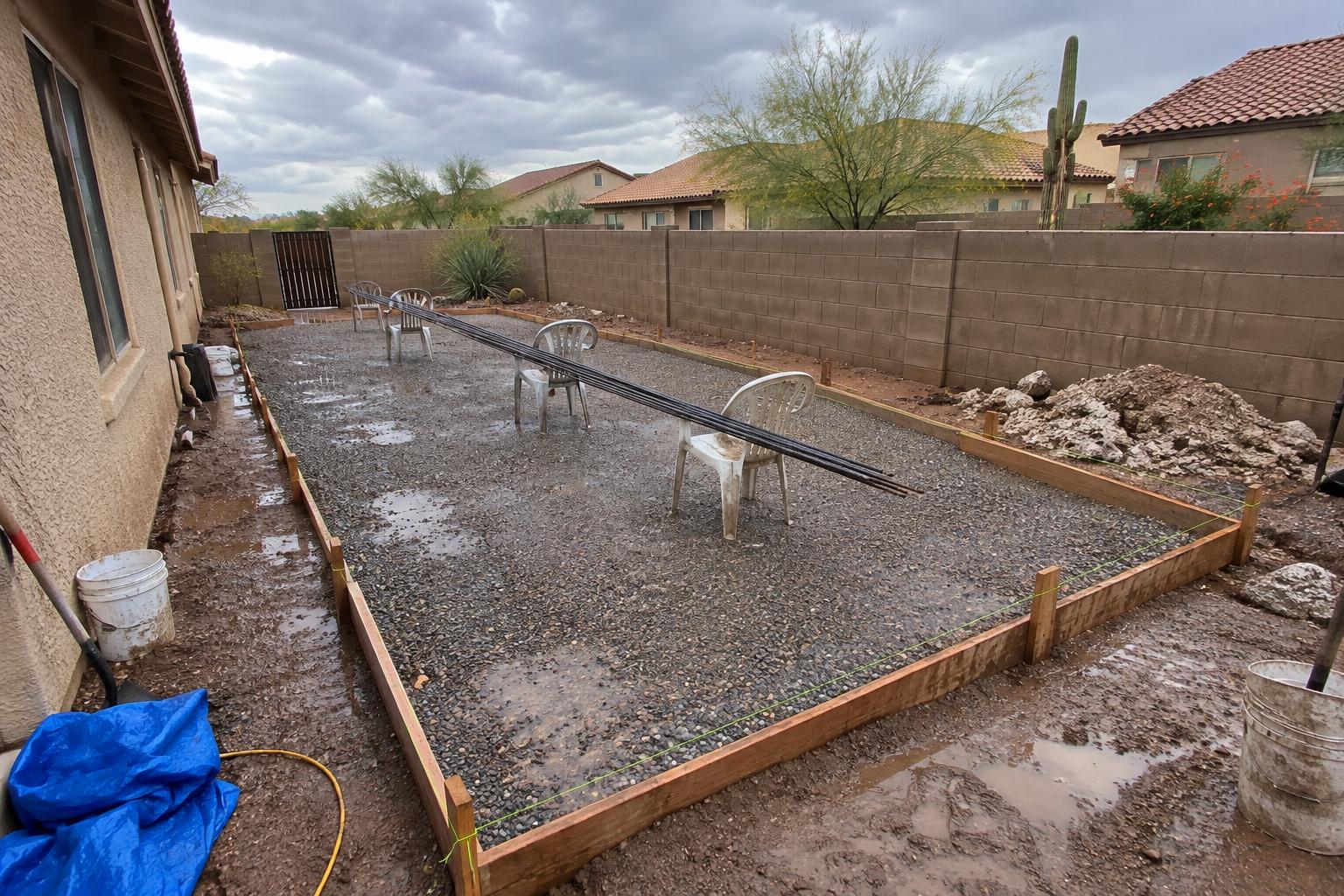
A lot of people assume a concrete patio contractor earns their pay on pour day, when the truck backs in and the slab takes shape. What actually decides whether a patio stays flat, sheds water and holds its color is the prep work that happens before any concrete shows up. In Downtown Mesa, that prep looks different than it does in a newer subdivision out in the far East Valley. It is worth understanding before you start collecting estimates.
What Downtown Mesa backyards tend to look like
Many homes around Main Street, the Evergreen and West Second Street areas, and the blocks near the Mesa Temple were built decades ago. Backyards often have an old patio slab poured by a previous owner, a cracked strip of concrete outside the back door, or bare dirt where the grass gave up. Mature citrus, ash and mesquite trees push roots toward water. Lots can be narrow, and access is sometimes through a side gate or off an alley.
Under the topsoil, most of the Phoenix Valley sits on some mix of caliche and expansive clay. Caliche is a cemented layer that can be as hard as rock. Clay swells when it gets wet and shrinks as it dries. Neither one makes a good surface to pour on directly, and both show up regularly in Mesa backyards.
Digging out and building a real base
The first job on a patio is removing what should not sit under it. That can mean breaking out an old slab, cutting back roots and excavating soft or organic soil. When we hit caliche, it gets broken up and graded so the base sits at a consistent depth. When we find clay, we dig it out to firmer ground where needed.
Then comes the base. Aggregate base material is spread, watered and compacted in lifts with a plate compactor. Forms are set to the planned shape and staked so the edges stay straight. Reinforcement goes in on chairs so it ends up in the middle of the slab's thickness. This is also when we set the slope. A patio should fall gently away from the house so water runs off toward the yard and away from your foundation and back door.
Planning a pergola, a ramada or an outdoor kitchen? Tell us now. Those features may need thicker sections or footings, and it is much easier to build them into the forms than to cut into a finished slab later.
Pouring in Mesa heat
Summer afternoons in Mesa regularly pass 110°F, and concrete reacts to that heat fast. Water leaves the surface quickly, the mix stiffens sooner and finishing turns into a race. That is why summer pours here start early, often right around sunrise, with the crew staged before the truck arrives.
After the pour, the slab is screeded to grade, floated, edged and given its finish. Control joints are tooled or saw-cut so the cracking concrete naturally does happens along straight, planned lines. Curing matters just as much as finishing. Keeping the surface from drying too fast in the first days helps the slab gain strength and resist surface cracking. We will explain how to care for the patio during that window and when it is ready for foot traffic and furniture.
Drainage, monsoons and flood irrigation
Monsoon storms dump a lot of water in a short time. Low spots fill, runoff carries dirt across the yard, and soil at the edge of a slab can wash out and leave the concrete undermined. A good plan looks at where water comes off the roof, where it goes once it hits the patio and where it leaves the yard.
Some older Downtown Mesa neighborhoods still use flood irrigation, which means the yard is periodically covered with standing water. If your property is on irrigation, the patio height, edge details and slope need to account for it so water stays where it belongs. Mention irrigation during the estimate so we can plan the elevations around it.
Finishes, color and sealer under the desert sun
A broom finish is practical and gives good traction near a pool or back door. Stamped concrete can mimic stone, slate or wood patterns. Exposed aggregate shows off the stone in the mix and hides dust well. Integral color adds warmth that suits the older brick and stucco homes downtown.
The sun here is hard on every one of these finishes. UV breaks down sealer over time, and color can fade on surfaces with full afternoon exposure. Resealing on a regular schedule protects both the color and the surface. A lighter finish on a sunny west-facing patio also stays more comfortable to walk on in July than a dark one. For a cooler surface around a pool, we install cool deck coatings as well.
Planning the project and the paperwork
Before anything is poured, it helps to settle a few things:
- How you will use the space: dining, a grill area, a pad for a hot tub or a shade structure. - Whether your home sits in a historic district or an HOA with rules about exterior changes, and whether the City of Mesa requires a permit for your scope. - How equipment and concrete will reach the backyard, especially on tight lots. - Whether other work makes sense at the same time.
That last point can save money and disruption. Many Downtown Mesa homeowners pair a new patio with a walkway to the side gate, new steps at the back door or a driveway replacement out front. If your drive is cracked or too narrow for your vehicles, our Concrete Driveway Contractor page covers how we handle tear-outs, extensions and RV pads.
When you are ready to talk about your own yard, start with our concrete patio contractor in Downtown Mesa page, then call Sam The Concrete Man North Phoenix at (602) 773-1313. We come out, look at the soil, the drainage and the access, and give you a free estimate. Financing is available for homeowners who want to spread out the cost.